

My father, a Polish refugee, was a member of the Civil Defence Corps. Civil Defence had been established in response to the emerging Cold War and the perceived risk of nuclear attack. It replaced local wartime civil defence services and reorganised them as a peacetime volunteer organisation serving to protect the civilian population, maintain continuity of government and essential services, and support recovery after a nuclear or major conventional attack. It was organised on a county basis, but was centrally directed by the Home Office. At its peak in the early 1950’s Civil Defence had more than 330,000 members.
He proudly wore a black serge uniform with beret that eventually made its way, with a gas mask, to the ‘dressing up box’ in my childhood home. It appeared in 2nd World War reenactments staged with my friends, and courageously supported by ‘Action Man’. My father told the story that when he had first put on the uniform, my grandmother, who was not given to tears, wept. It had recalled the moment at the onset of war that her husband had donned his Polish Army uniform and the subsequent separation, pain and suffering. On this occasion my father was heading to Hendon Town Hall.
As my father was a professional physicist he was assigned to the Scientific & Reconnaissance Section principally responsible for radiological monitoring in the event of a nuclear attack, but also concerned with the effects of chemical and biological weapons, and with damage assessment more generally. It was closely linked to the UK Warning & Monitoring Organisation and the Royal Observer Corps, which maintained a network of monitoring posts, bunkers and control centres. My father trained and exercised across Middlesex, keeping the suburbs safe for democracy, a mission he was properly committed to (as am I).
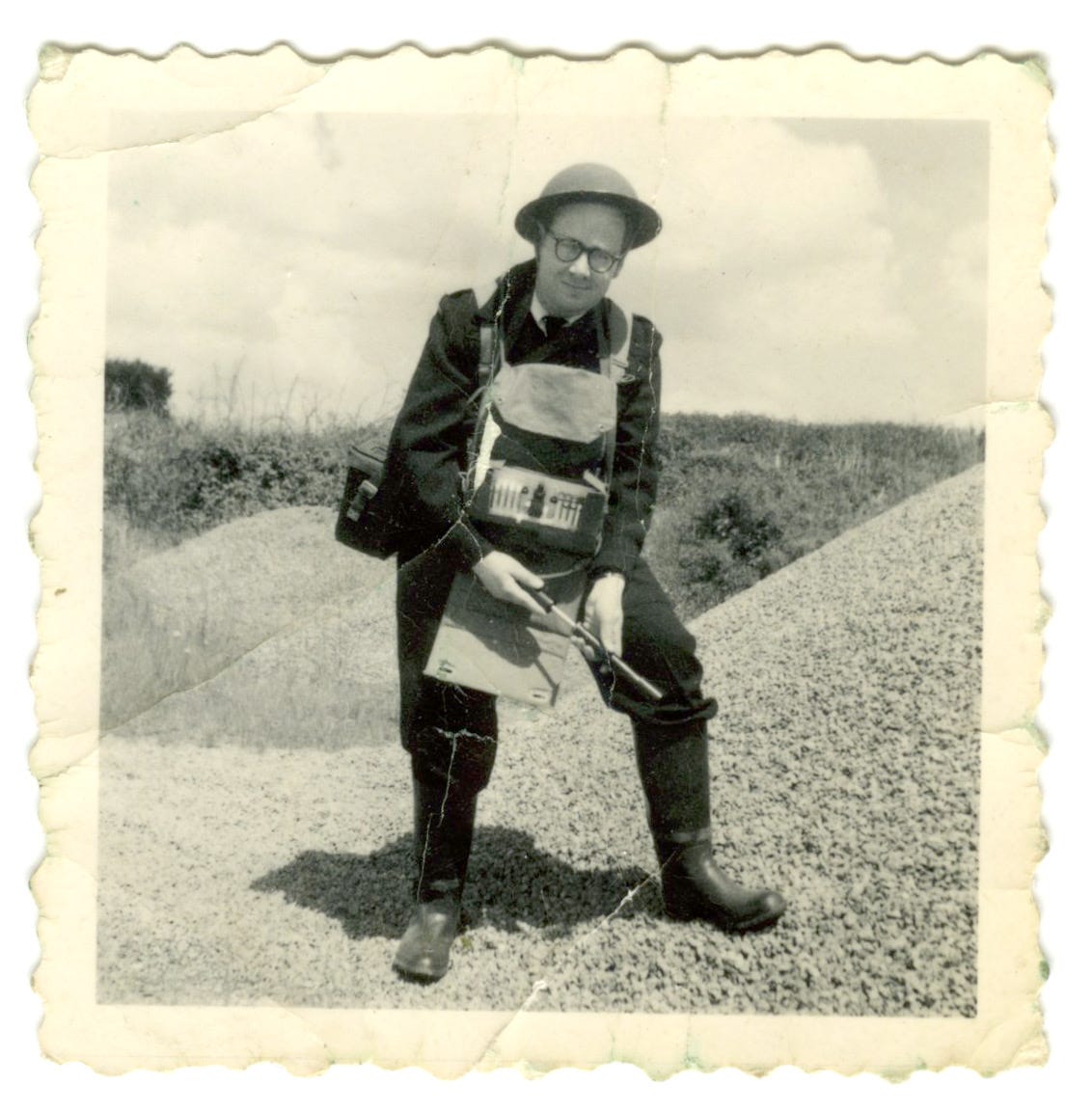
Ludwik Finkelstein on duty with the Civil Defence Corps
In 1968 the Civil Defence Corps was disbanded. It had lost much of its social and political buy-in, and there was growing scepticism that, given the scale and capability of nuclear weapons, a concerted nuclear attack would be survivable. My father was however, not demobbed. A new Scientific Advisory group, comprised of professional scientists and engineers, was established to maintain and develop the expertise, principally on recovery from a nuclear (chemical and biological) attack. It also formed the nucleus for an advisory capability for national, regional and local government. The tasks included predicting weapons effects, plotting fallout, assessing damage and planning for reestablishing critical services. This called for expertise in modelling and a range of more arcane skills, but principally the ability to provide advice in emergencies.
The Scientific Advisers were not exactly secret but but rather discreet. The work relied upon a range of classified sources including attack scenarios, knowledge of weaponry, and data from nuclear tests. Certainly, my father did not speak much about the detail, and the paperwork was kept in a small Home Office combination safe in his study (that on one occasion got stuck, and the approved safe-breakers had to be summoned from Whitehall).
On the completion of my Master’s Degree, my father asked me whether I would consider joining. I felt honoured, I knew it was important to my father, and that his suggestion was a sign of his trust. Of course, I loved and admired him. So I went to an anonymous building, The Office of the Government Chemist as I recollect, was interviewed, and sometime later received a letter from the Home Office appointing me. I joined Dad’s Army ... literally.
There followed an extensive training, with evening sessions at the Greater London Council (GLC) close by Waterloo, at the Greater London Emergency Control Centre (GLECC) beneath Kingsway, and at the London Fire Brigade HQ on the Albert Embankment. We organised exercises at, amongst other venues, Kelvedon Hatch, the intended Regional Government Headquarters for London, near Brentwood in Essex, where I scribbled hypothetical casualty figures on glass boards with a ‘chinagraph pencil’.
I recall weekends at Bramshill House, the Police Staff College, where the staff expressed concern that the scientists were too abstemious, having laid in alcohol suitable for a police event. We would regularly attend courses at Easingwold Manor, originally the Civil Defence College and later the Emergency Planning College. At Easingwold, they would wake you in the morning with a cup of tea placed on the bedside table, even then it seemed like another era. I still wear my Emergency Planning College tie, which reminds me of my father, and of a tradition of technical public service.
This is probably not how many people spent their twenties. Show me the boy and I will show you the man, I guess. I do not regret a moment of it. Now I think back on it, it was simultaneously both somewhat comic and deeply serious.
In 1992 or thereabouts, the Scientific Advisers were disbanded. I received a formal letter of thanks. My wife, Judy, expressed relief, she had not liked the idea that I would abandon our young family in the event of a national emergency. I was proud to have served, but missed it.
I had not originally intended to write this story. The plan had been to write something analytical about a ‘whole-of-society’ approach to national security. Yet this account serves to illustrate some of the same points. Resilience rests not only on formal institutions but also on the commitment of individuals who choose to serve. My father understood that.
Lovely piece. Do you know if such a group still exists? I worry that so much of this kind of ‘human infrastructure’ we developed in the Cold War years has dissolved over time, leaving us far less resilient as a society.
Ally - the short answer is yes. There are multiple reserve units you can join including SGIS, 3MI, 77 brigade and others that specifically look for those of a more scientific bent and experience and bring them int the services to tackle some of the most difficult challenges. At the grand old age of 50 I have just joined up myself.
And to Anthony - I really nice piece. You probably won't remember me, but we served together in the scientific community in defending the realm.